

Nestled between the historic and the modern alignments of Route 66, the National Museum of Transportation houses one of the largest collections of transportation vehicles in the world. Can you think of a more fitting pit stop on your St. Louis journey?
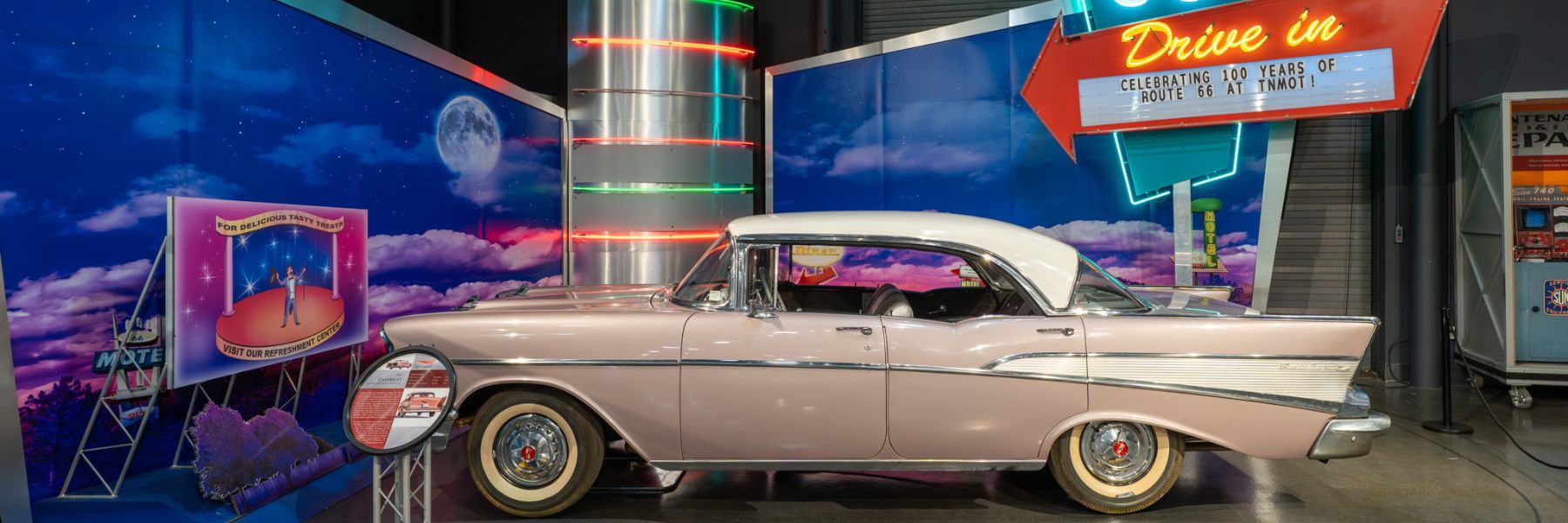
Celebrating the Mother Road’s centenary, the museum’s new exhibition, Roads, Rivers, Rooms and Reels, explores the stories, memories and modes of travel that shaped America’s most iconic highway and the communities connected to it.
With two iconic features anchoring the exhibition, visitors will experience a stunning model of the S.S. Admiral, honoring the legendary riverboat that once defined river travel and entertainment in the Midwest. It will also spotlight the beloved ‘66’ Park-In Theatre on Watson Road, owned by the Wehrenberg family of St. Louis, which remains a treasured symbol of drive-in movie culture and shared experiences along Route 66.
Beyond the special exhibition, the National Museum of Transportation remains a destination in its own right, offering a wide range of attractions for multigenerational travelers. While you’re here, don’t miss these highlights, each notable for its scale, design and historical significance.

Union Pacific Steam Locomotive #4006
Built in 1941, the “Big Boy” isn’t the most powerful steam engine in history, but nothing else compares to its combined power, speed and agility. In its heyday, the behemoth hauled heavy freight trains over the mountains between Cheyenne, Wyoming, and Ogden, Utah, accumulating more than one million miles of service. Only eight of the 25 original engines remain, and the National Museum of Transportation boasts the one that traveled the farthest.

DiDia 150
Designed by clothier Andrew Di Dia and custom-built by four workers in Detroit, Michigan, between 1953 and 1960, Bobby Darin’s ruby-red “Dream Car” cost more than $93,000 to assemble. One of the wildest concept cars of the 20th century, the flashy, futuristic automobile has 30 coats of paint featuring ground industrial diamond dust to add sparkle, along with hidden windshield wipers, retracting headlights, swiveling turn signals and no door handles! The air conditioning is thermostatically controlled, and each of the four rust-colored bucket seats contains a cigarette lighter, ashtray and concealed speaker. The original Cadillac V8 engine was replaced by a Ford 427/365 hp V8 engine, and the body and chassis are hand-formed in aluminum with an aluminum alloy welded tube frame. The popular singer regularly used the car for public appearances, including the 33rd Academy Awards in 1961.
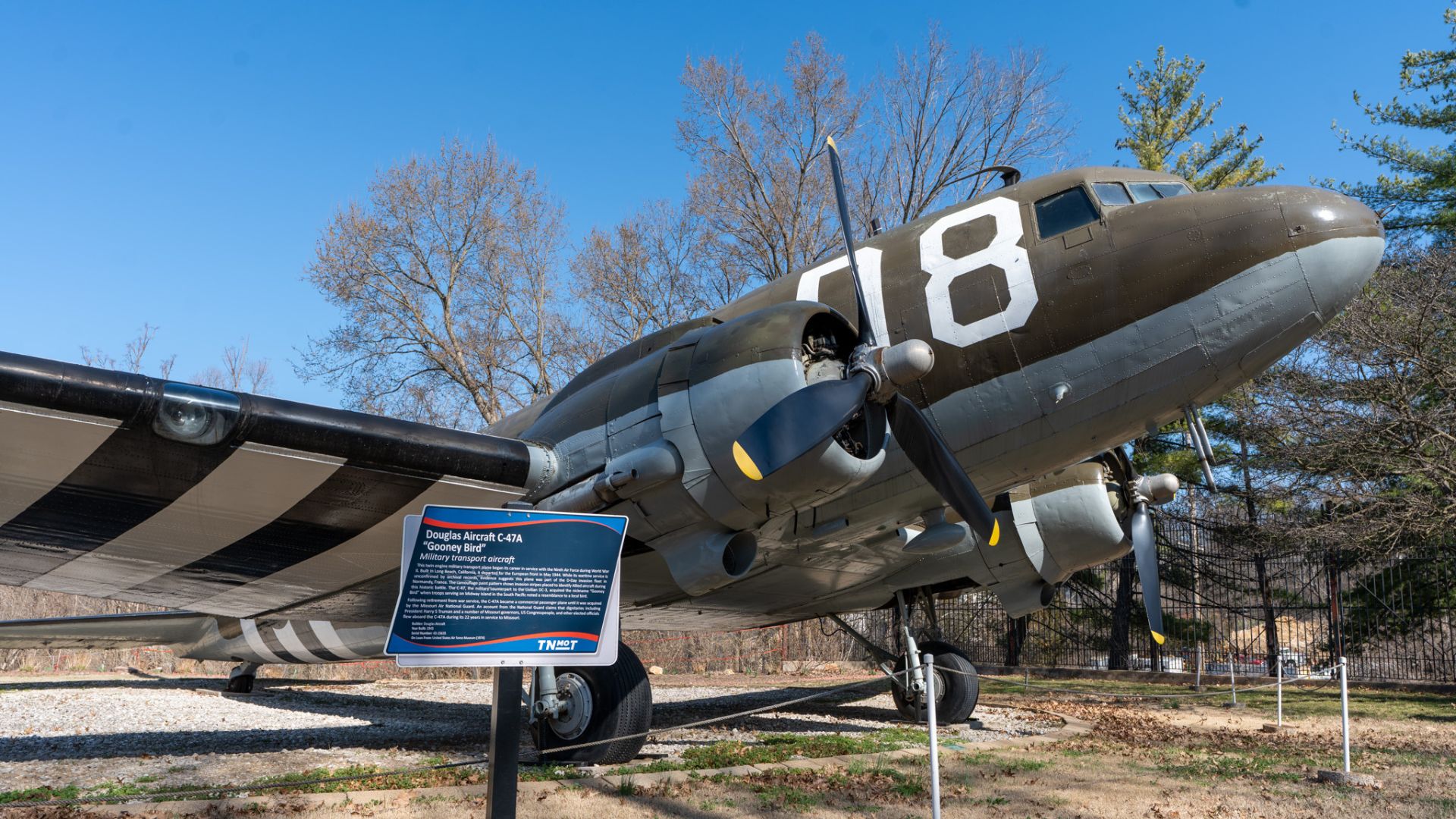
U.S. Army Air Force Douglas Aircraft C-47A #N 3-15635
This twin-engine aircraft, built in 1943 by the Douglas Aircraft Company, changed the course of history. Capable of carrying 28 paratroopers, 600 pounds of cargo or 14 stretchers of wounded soldiers with medical attendants, it was used by the U.S. Army Air Force to resupply troops the day after the Normandy landings, securing its place as a World War II veteran. Painted in camouflage with distinctive invasion stripes to identify it as an Allied aircraft, the plane proved both agile and dependable. A paratrooper with the 82nd Airborne Division recalls flying in a C-47, affectionately known as the “Gooney Bird,” during the early morning hours of June 6, 1944: “My plane was one of 2,000 aircraft used in the invasion of France during World War II, and we called it ‘That’s All, Brother’ – a message to Hitler that his war was coming to an end.”

H.T. Pott Towboat
At the National Museum of Transportation, visitors can walk the decks of the H.T. Pott, the first Missouri River towboat with a welded steel hull rather than a riveted one. Operating out of Kansas City, Missouri, the vessel was named for Herman T. Pott, a prominent river transportation executive and entrepreneur. Despite their name, towboats push barges from the back instead of pulling them from the front – a role essential to moving goods along the nation’s rivers. A woman recalls her father-in-law’s stories of working on the rivers: “His love of river life began at an early age, and he found happiness as a deckhand on a barge line. The river seeps into your blood, and men aboard the towboats often felt like they had two families: one on land and one on water.”

F/A-18 E1 Super Hornet
This U.S. Navy supersonic fighter jet – the first Super Hornet ever produced – was built by Boeing right here in St. Louis. It first flew in 1995, and the F/A-18E has since assisted the armed forces of the U.S., Australia and Kuwait.

Virgin Hyperloop XP-2 Pegasus Pod
Tomorrow’s transportation arrives in the form of Virgin Hyperloop’s Pegasus pod. Direct from the Smithsonian Institute’s Futures exhibit, the XP-2 can reach speeds of up to 670 miles per hour, representing the first major leap forward in mobility in a century. In late 2020, Virgin Hyperloop made headlines worldwide when its first passengers completed a successful test run, turning a long-imagined science-fiction concept into reality. Distances that once took months, then hours, might soon take only minutes.

Chrysler Turbine Car
The Chrysler Corporation built a total of 55 Turbine cars between 1962 and 1964. Every car’s body was handmade by Italian design studio Ghia before being shipped to the U.S. for installation of its engine – capable of running on a variety of fuel sources. The two-door hardtop coupes featured power brakes and power steering, and all were painted in an identical color known as Turbine Bronze. At the National Museum of Transportation, the Chrysler Turbine car is parked in front of the preserved Art Deco façade of the Coral Court Motel, a Route 66 landmark that operated until 1993.
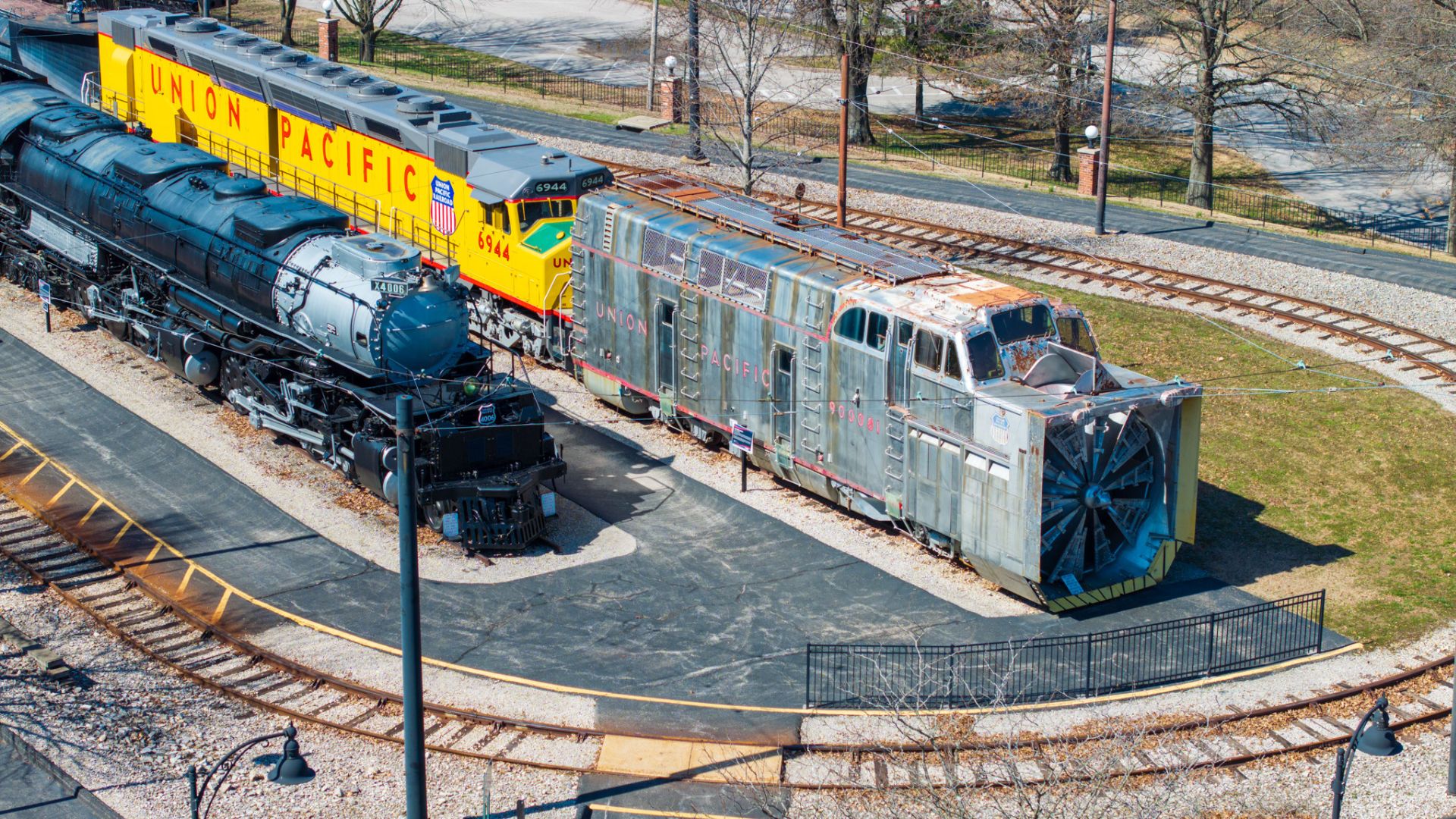
Union Pacific Rotary Snowplow #900081
The largest and heaviest rotary snowplow ever built, the Union Pacific #900081 weighs an astonishing 376,400 pounds – approximately the equivalent of 62 African elephants! Designed to tackle the most extreme winter conditions, its massive 12-foot cutting wheel could chew through deep drifts and hurl snow far from the tracks on either side. Hydraulic wings extended outward to carve a path up to 14 feet wide, allowing trains to pass through otherwise impassable routes. Built for power rather than speed, this formidable machine played a critical role in keeping vital rail lines open during harsh winters, showcasing the ingenuity and sheer scale of railroad engineering.

St. Louis Motor Carriage
This 1901 automobile still draws audible oohs and aahs from visitors. Built by the St. Louis Motor Carriage Company, it’s the oldest of only nine such cars still in existence. Founded by George Preston Dorris and John French, the company helped shape the early automobile industry; Dorris also developed and patented the carburetor float, an innovation that improved fuel regulation and engine performance. As the first successful automobile manufacturer west of the Mississippi River, the St. Louis Motor Carriage Company played a pivotal role in bringing horseless transportation to a rapidly modernizing nation.